
Home › Blog › A Day in the Life at Big Blue Surf Experience
A day at the Big Blue Surf Experience camp starts with breakfast and the forecast, not an alarm clock set to a fixed lesson. You eat first, you find out which of the eight breaks the ocean is giving us that morning, and then you go. The rest of the day fills in around that single decision: surf, lunch, work or rest, a second session if the tide allows, and long tables at night.
We run four accommodations, a surf school, a coworking space, scooter rental and airport transfers in Taghazout, all under one team and one booking. This is what a full day actually looks like, hour by hour, so you can picture the week before you book it.
How the day starts at the Big Blue Surf Experience camp
Breakfast is included on direct bookings and on packages, and it does more than feed you. It is where the day gets decided. You come down, you eat, and the coaches tell you which spot we are heading to and why. The spot is chosen each morning from the forecast. We do not promise a wave or a specific break, because the ocean decides that, not us.
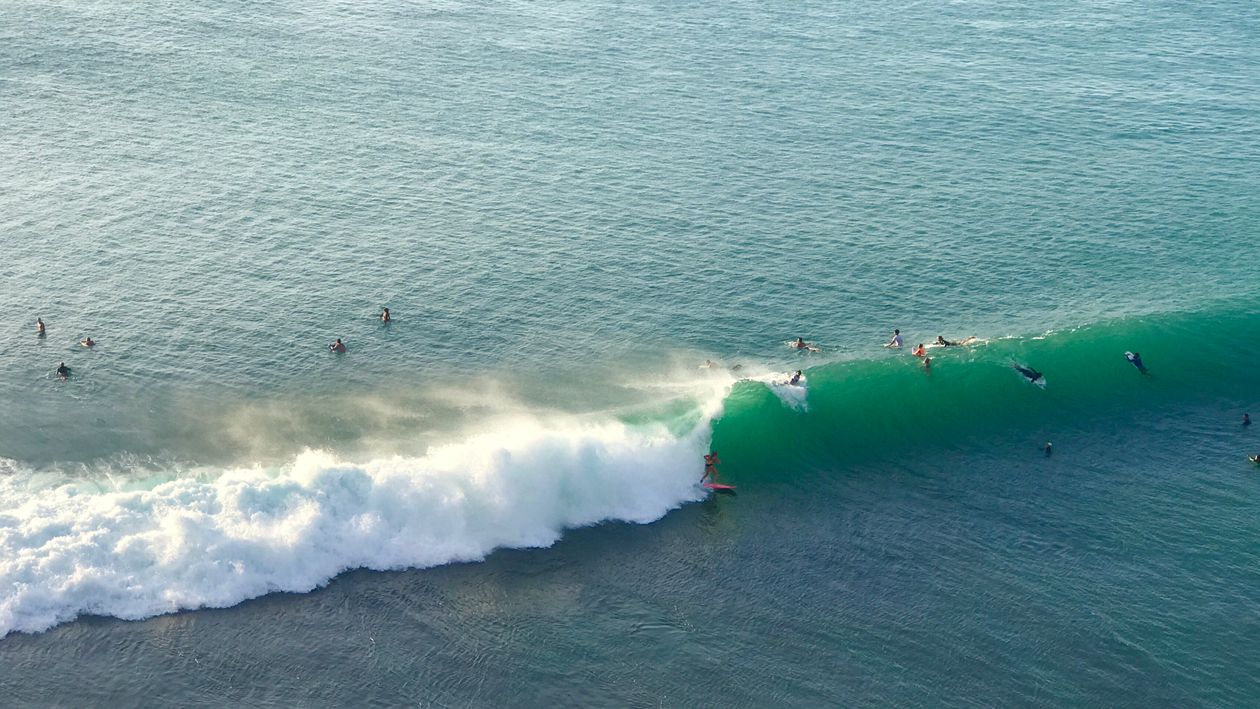
There are eight breaks within reach of the camp. Some suit a first lesson, where sand is slower than water and hurts less. Others are for people chasing a cleaner, faster wave. Over breakfast you learn which one fits the swell, the wind and the tide that day. Each of the breaks within reach rewards a different level and mood, which is why the choice is made fresh every morning.
Heading out: lessons and free surfs
After breakfast, the vans load up and we drive to the chosen spot. Surf groups are eight people maximum per certified coach, split by level into beginner and intermediate. The coach is in the water with you, not watching from the edge with a clipboard. That is the detail most camps gloss over, and it is the one that matters most when you are learning.
Beginners work on the basics in the whitewater first: popping up, finding your feet, reading the foam. Intermediates go out the back and work on positioning and turns. If you have never surfed, the first few sessions are mostly whitewater and small wins: one clean pop-up, one wave ridden all the way in.
A free surf runs alongside the lessons for anyone comfortable enough to paddle out on their own. And if the sea is flat or you are tired, watching from the edge with a coffee is also a legitimate activity. Nobody is forcing you into cold water to tick a box.
What a morning session includes
- A coach in the water with your group, eight people maximum
- Boards and wetsuits sized to you
- A spot picked that morning for your level and the conditions
- Groups split so beginners and intermediates are not mixed
Lunch and the quiet middle of the day
By early afternoon you are back at the camp, salty and hungry. Lunch and the hours after it are the quiet part of the day. This is when the camp slows down on purpose. Some people sleep. Some sit on the rooftop. Some sort out logistics for the days ahead.
The middle of the day is also when the fixed seven day activity cycle comes into its own. The programme runs the same every week of the year, which means you can plan around it before you land. One afternoon it is quad bikes. Another it is Paradise Valley, a gorge of palm trees and cold green pools about an hour from Taghazout. Later in the week it might be Souk El Had in Agadir, a hammam, or the dunes at Timlaline.
Morocco is not a quiet corner of the travel map, which is part of why Taghazout keeps growing as a base. The country welcomed 19.8 million tourists in 2025, a 14 percent increase on the year before (Morocco Ministry of Tourism, via The Media Line, January 2026). You feel that energy in the souk and on the roads, but not at the camp itself, which stays small.
Coworking and the afternoon surf
If you came to work as well as surf, the afternoon is where the two meet. The camp has a coworking space, and Stay and Work bookings start from two nights. The rhythm most remote workers settle into is simple: surf in the morning when your head is clear, work through the afternoon, then catch a sunset session if the tide cooperates.
This pattern is more common than it used to be. The global surfing tourism market was valued at 71.7 billion dollars in 2025 and is projected to reach 118.9 billion dollars by 2033 (Grand View Research, 2026). A growing share of that is people who no longer separate the trip from the job. If that is you, our digital nomad guide to Taghazout covers the wifi, the desks and the practical side of working from here.
A second surf is not guaranteed every day. It depends on the tide, the light and how much the morning took out of you. Some afternoons the better call is a scooter ride up the coast to watch the waves instead of ride them.
Evenings at the long tables
Dinner is where the camp turns back into a group. The long tables fill up with people who were strangers at breakfast and are now comparing wipeouts. Solo travellers tend to arrive worried about eating alone and leave with a group chat. The food is Moroccan, the conversation is loud, and nobody checks your surf level at the door.
The evening is not programmed. There is no forced entertainment, no schedule for the night. Some people stay up on the rooftop. Some are asleep by ten because a full day in the ocean does that to you. Either is fine. The point of the long tables is that the social part happens on its own, because you have all spent the day doing the same thing.
What makes our camp different
The spot changes, because the ocean changes. That is the honest centre of how we run the week. We do not sell you a fixed itinerary and then pretend the sea will cooperate. We read the forecast each morning, pick from eight breaks, and swap the day rather than cancel it when the conditions move.
The other difference is that everything sits under one team. Four addresses, one booking. Your room, your lessons, your coworking desk, your scooter and your Complimentary Departure Transfer are all handled by the same people, so you are not stitching a trip together from five different suppliers. The Complimentary Departure Transfer to Agadir Al Massira Airport or Agadir Bus Station is included from five nights on packaged trips. The arrival transfer is not included, and we say so plainly rather than let you find out at the gate.
Stays and packages can be cancelled free of charge up to seven days before arrival. Services booked on their own can be cancelled up to 48 hours before they start. Those are the rules, written down, not buried.
If this is the kind of week you want, the next step is small: pick your dates and build your trip around the surf and the seven day cycle. Choose one of the ready-made packages or put your own together, and the morning forecast will take care of the rest.
Questions people ask
What time does the surf day start at the Big Blue Surf Experience camp?
You find out at breakfast which spot you are going to, then head out for the morning session. The exact time shifts with the tide and the forecast, so it changes day to day.
How many people are in a surf group?
Eight people maximum per certified coach, split by level into beginner and intermediate. The coach is in the water with you, not watching from the sand.
Can I work remotely and still surf at the camp?
Yes. The camp has a coworking space, and Stay and Work bookings start from two nights. You can surf in the morning and work in the afternoon, or swap it around.
Is breakfast included?
Breakfast is included on direct bookings and on packages. It is served in the morning before the surf check, so you eat before you decide where to go.
What is the seven day activity programme?
A fixed seven day cycle that runs the same every week of the year: quad rides, Paradise Valley, the souk, a hammam, the dunes and more. You can plan around it before you land.