
Home › Blog › Remote Work Surf Camp: Coworking by the Waves
A remote work surf camp is accommodation built for people who still have a job. You get a real desk, fast internet and a quiet corner, plus daily surf and a community to eat dinner with. You work your full hours. You just do it two minutes from the beach, and you plan the day around the tide instead of the office.
This is not a holiday where you answer a few emails. It is your normal working week, moved to Taghazout. The reason these camps now exist is simple: there are a lot more of you. MBO Partners counted 18.5 million American digital nomads in 2025, up 153% since 2019 (MBO Partners, 2025 Digital Nomads Trends Report). When that many people work from anywhere, somewhere has to be built for them to land.
Here is what the week actually looks like, and how to make the work half fit around the water.
A real day: dawn, deep work, lunch, then the water
The day runs in blocks, and the ocean sets the first one. We check the forecast each morning and pick the spot from eight breaks within reach, so you find out at breakfast which beach you are driving to. A dawn session gets you in the water before your inbox wakes up. Then you work.
Here is a day that most people settle into by the third morning:
- Early: coffee, then the first surf while the wind is still light.
- Mid-morning to early afternoon: your main deep-work block at a desk, calls included.
- Lunch at the long table, where you find out what everyone else is building.
- Late afternoon: a second surf, or the fixed activity of the day.
The afternoon is where Taghazout earns its place. One day it is a gorge of palm trees and cold green pools at Paradise Valley. Another it is the stalls and spice piles of Souk El Had in Agadir. The activity cycle is fixed and runs the same every week of the year, so you can look at the calendar before you book and know what you will miss if you spend an afternoon on a deadline instead.
The honest part: watching from the edge with a coffee is also a legitimate activity. Some afternoons the work wins, and that is fine. The surf is there tomorrow.
What a remote work surf camp needs: wifi, desks, power and a quiet corner
A remote work surf camp lives or dies on its desk. You need a real chair, a stable connection, a plug that works, and somewhere quiet to take a call. Morocco now runs the fastest mobile internet in Africa, at 124.32 Mbps, ranking 39th in the world after the 5G rollout in late 2025 (Hespress, citing the Ookla Speedtest Global Index, 2025). So the country is no longer the weak link it once was.
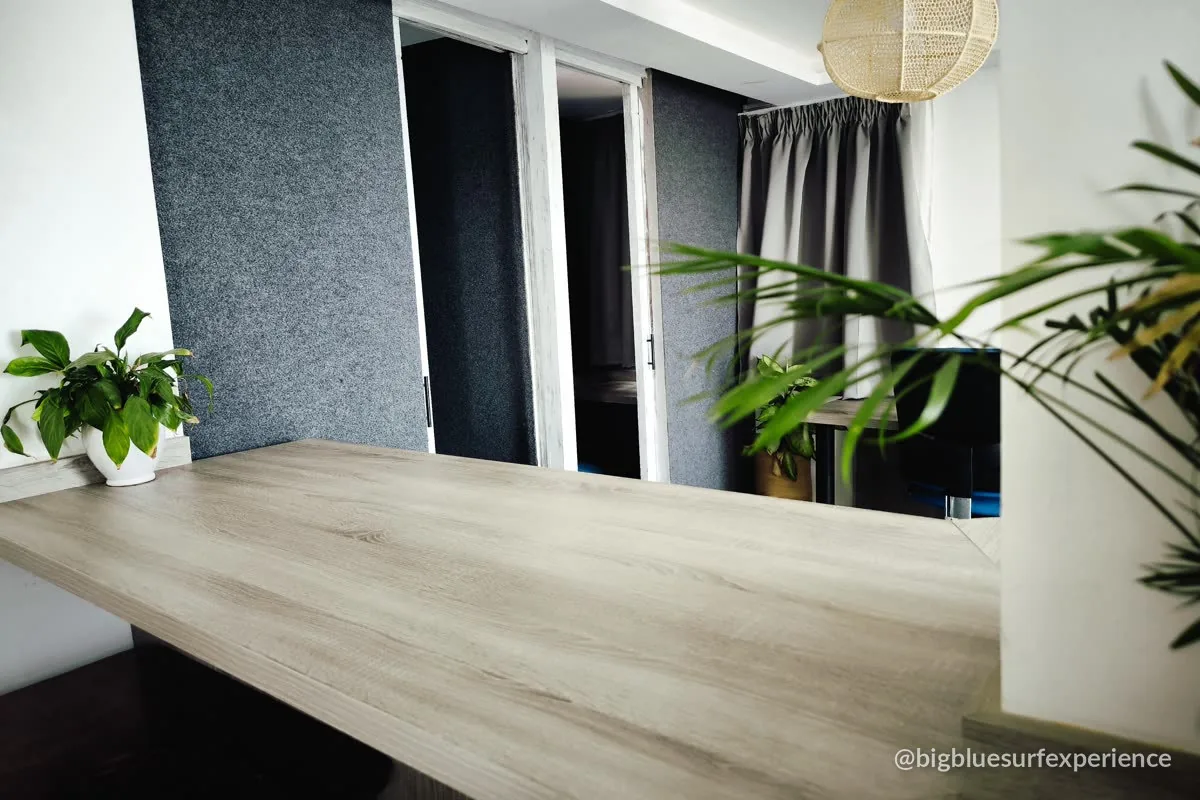
Inside the coworking space the setup is practical. Desks you can sit at for six hours without your back complaining. Power at every seat, so you are not hunting for a socket mid-call. A quiet corner for the calls you cannot have other people talking over. And fibre with a backup line, because a dropped video call in front of a client is the one thing a sea view does not excuse.
What matters is that work and surf share one roof and one booking. You are not commuting between a flat, a café with patchy signal and a surf school across town. The desk, the bed and the board are all in the same place.
How to stack your calls around the tide
The trick to a work and surf week is treating the tide like a meeting you cannot move. The best surf usually lines up with a particular tide and wind, and those windows shift by roughly an hour each day. So your calendar should bend around the water, not the other way round.
A few things that work in practice:
- Front-load calls into the hours when the tide is wrong for your level, and surf when it is right.
- Block the two hours around the better tide as "busy" and defend them like any other meeting.
- Keep one long uninterrupted block for deep work. Two short sessions in the water beat one long one if it means you protect that block.
- Tell your team your hours shift slightly day to day. Most people will not notice; the few who do usually just want to know when you are reachable.
Because the spot changes with the forecast, you will not know the exact timing until the morning. That sounds chaotic. It settles fast. By day three you stop fighting it and start reading the week in two-hour chunks. If you want the full rhythm of a work and surf week, our digital nomad guide to Taghazout breaks it down day by day.
Community over isolation: long tables and call-free zones
The quiet failure of remote work is loneliness, not productivity. Working from anywhere often means working alone, and a surf camp fixes that by accident. You eat at long tables with people who also spent the morning in the water. You learn what a Berlin product designer and a freelance copywriter from Lisbon are actually working on. Dinner becomes the standup you did not schedule.
The space only works if it respects two different needs at once. So there are call-free zones, where you can read or think without someone pitching a client two feet away. And there is the common area, where talking is the point. Weekends open up for longer trips: the sand at Timlaline, the long right at Imsouane, a day you could never fit around a Tuesday call.
This is the part a flat with good wifi cannot give you. A desk makes you productive. A long table full of people doing the same strange thing you are doing makes you want to stay another month. And many do: the same MBO Partners report found 89% of digital nomads now use AI in their work, which is to say the people at the table are often building things worth talking about.
Book a longer stay and set up your desk two minutes from the beach
The one real rule of a remote work surf camp: stay longer than you think. A week is enough to find the rhythm. A month is where it starts to feel like your life rather than a trip. Stay and Work starts from two nights if you want to test it, but the people who get the most from it are the ones who unpack properly.
The practical details are plain. Breakfast is included on direct bookings and on packages. The Complimentary Departure Transfer to Agadir Al Massira Airport or the Agadir bus station is included from five nights on packaged trips; the arrival transfer is not. Stays can be cancelled free of charge up to seven days before arrival, so booking early costs you nothing if your work calendar moves.
Pick your dates, choose a package or build your own, and set up your desk two minutes from the water. The forecast will tell you the rest in the morning.
Questions people ask
What is a remote work surf camp?
It is accommodation that combines a proper coworking space with daily surf coaching and a social community. You keep your job, work full hours at a desk, and surf around the tide. Stay and Work with us starts from two nights.
Is the wifi fast enough for video calls in Taghazout?
Morocco now has the fastest mobile internet in Africa, at 124.32 Mbps, so coverage is solid. We run our coworking space on fibre with backup, so you can take calls without the sea in the background dropping you.
Can I really work full-time and still surf every day?
Yes. Most people do a dawn session, a long deep-work block, lunch, then a second surf or an afternoon excursion. The spot is chosen each morning from the forecast, so you plan your calls around the better tide window.
How long should I book for a work and surf trip?
Longer than a holiday. A week lets you find a rhythm, and many people stay a month or more. Stay and Work starts from two nights, and the Complimentary Departure Transfer is included from five nights on packaged trips.