
Home › Blog › Taghazout Travel Guide: Beyond the Surf
Taghazout is a small fishing village 20 km north of Agadir, and you can walk its whole length in about fifteen minutes. This Taghazout travel guide is for the hours you are not in the water: how to arrive, how to get around, where to eat, what to do with cash and a phone, and which day trips are worth the drive. We run four stays and a surf school here, so most of this is just what we tell people at breakfast.
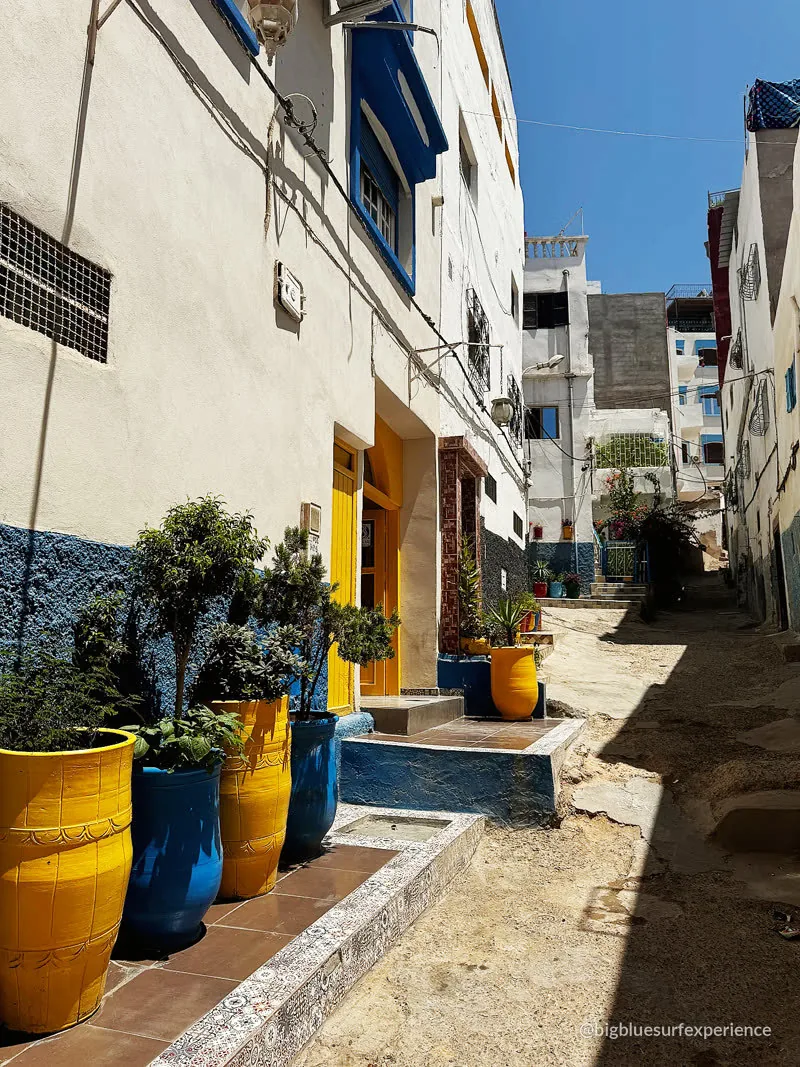
Taghazout has about 4,861 residents, according to Morocco's 2024 census. That number matters, because it tells you what to expect. One main road along the coast, blue boats on the sand, cats on every wall, and the Atlantic at the end of every lane. It is a village, not a resort.
Getting there, getting around and how the village actually works
Almost everyone flies into Agadir Al Massira Airport. From there it is roughly a 45 minute drive north to Taghazout. A taxi at the rank will take you, or you can arrange a transfer in advance so someone is waiting with your name. On packaged stays of five nights or more we include the Complimentary Departure Transfer back to the airport or the Agadir bus station at the end of your week. The arrival transfer is not included, so plan that leg yourself.
Inside the village you walk. There is one road and a handful of lanes dropping to the beach, so nothing is far. For anywhere beyond the village, the easiest option is a scooter. You can reach Tamraght in ten minutes, Anchor Point in five, and the quieter beaches to the north in under half an hour. We rent scooters on site, and the practical stuff, licence, helmet, where to park, is in our scooter rental in Taghazout guide. Shared grand taxis run the coast road too, cheap and frequent, if you would rather not drive.
The rhythm of the village follows the tide and the call to prayer. Cafes open early for the surfers. Shops shut for a couple of hours in the afternoon and come back to life at dusk. Nothing is rushed, and you should not be either.
Where to eat, sip coffee and watch the sunset off the rooftops
You will eat well and cheaply. Fish comes off the boats on the beach, grilled whole with bread, salad and olives. Tagines cook slowly in the back of small kitchens, chicken with preserved lemon, beef with prunes, vegetable for anyone who asks. Fresh orange juice is everywhere and costs almost nothing.
Coffee is a ritual, not a takeaway. Order a nous nous, half coffee half milk, sit on a rooftop, and watch the line-up for an hour. Mint tea arrives sweet and poured from height. In the mornings, order khobz, msemen or beghrir, flatbreads and pancakes with honey and oil, the same breakfast we put out on the long tables at our stays.
For sunset, go up. The rooftops face due west over the Atlantic, so the whole village tilts toward the horizon as the light goes. Watching from the edge with a coffee is a legitimate end to the day.
Cultural etiquette, money, SIMs and tipping made simple
Morocco is warm and welcoming, and a little respect goes a long way. On the beach, surf gear is normal. In the village and especially inland or in Agadir, cover your shoulders and knees a bit more. Ask before photographing people, particularly in the souk. Learn two words: salam for hello, shukran for thank you. They open doors.
Money runs on the Moroccan dirham, and it is a closed currency. You cannot buy it before you arrive, and you are not allowed to carry large amounts out. Change money at the airport or in town, and keep cash on you. Souks, grand taxis, small cafes, hammams and tips are all cash only. Cards work at larger hotels and some restaurants, but never assume. ATMs exist in Taghazout and plenty in Agadir.
For data, buy a local SIM. Maroc Telecom, Orange and Inwi all sell prepaid tourist SIMs with generous data, available at the airport on arrival or from shops in the village for a few dirham. Bring your passport to register it. Coverage along the coast is good, and most stays have wifi, including our coworking space if you are here to work as well as surf.
Tipping is expected but small. Round up the taxi, leave a few dirham for a good coffee, a little more after a sit-down meal. In the hammam, tip the person who scrubs you. None of it is fixed, and a genuine thank you counts for a lot.
Day trips: Paradise Valley, Imsouane, Agadir and the dunes
The best thing about Taghazout is how much sits within an hour of it. These are the four we send people to.
Paradise Valley. Inland from Agadir toward the Atlas foothills, a gorge of palm trees and cold green pools cut into the rock. You walk in along the riverbed, swim, and some people jump from the lower ledges. Go in the morning before the day-trippers, bring water and shoes with grip.
Imsouane. An hour north, a horseshoe bay with a long, mellow right-hander that peels for hundreds of metres. It is one of the longest rides in the country and forgiving enough that intermediates love it. There is a sleepy fishing port and a few cafes above the beach.
Agadir and Souk El Had. Twenty minutes south, Agadir is a modern city with a long beach and one of the largest markets in North Africa. Souk El Had is a walled grid of thousands of stalls behind more than a dozen gates: spices, leather, olives, lamps, argan oil. Go with a plan and a budget, and haggle gently. Souk El Had closes on Mondays.
The Timlaline dunes. Inland, a pocket of real Sahara-style sand where you can board down the slip face. Sand is slower than water and hurts less, which makes it a good day off your feet.
Use this Taghazout travel guide to plan, then build your week around the waves
The point of knowing all this is simple. Once you can find cash, grab a SIM, read a sunset and pick a day trip, the rest of your week is free to follow the ocean. The spot changes every morning because the ocean changes, and you find out at breakfast which break you are heading to. Around that, the excursions above fill the afternoons.
If you want the week handled for you, our Feel Alive packages pair morning surf with a fixed seven-day run of Moroccan adventures, the same cycle every week of the year. Or build your own stay from the pieces you want. Pick your dates, choose how many nights, and we will sort the surf, the scooter and the Complimentary Departure Transfer on the way home. Come for the waves. Stay for everything around them.
Questions people ask
How far is Taghazout from Agadir airport?
Agadir Al Massira Airport is around a 45 minute drive from Taghazout. A taxi or a pre-booked transfer is the simplest way to cover it.
Do I need cash in Taghazout?
Yes. Souks, taxis, small cafes and tips all run on cash in dirham. Cards work at larger hotels and some restaurants, but never rely on them alone.
What is the best time to surf in Taghazout?
October to March brings the biggest, most consistent winter swells. The shoulder months are gentler and better for first timers, and you can surf year round.
Is Taghazout good for non-surfers?
Yes. Paradise Valley, the Agadir souk, hammams, sunset rooftops and the Timlaline dunes all sit within easy reach, so a non-surfing partner has plenty to do.