
Home › Blog › How to Stand Up Surfing on Your First Wave
To stand up surfing, you catch a broken whitewater wave, push your chest off the board with your hands, and bring your feet under your body in one fast movement. No knees. No pausing halfway. You look up at the beach, not down at your feet, and you ride the foam standing. That is the whole skill, and most people get it on their first day in the water.
Learning how to stand up surfing is less about strength and more about sequence. Do the steps in the right order and the board does a lot of the work. Do them out of order, or hesitate in the middle, and you fall. Here is how the pop-up actually works, what trips up beginners, and how to build it until it is automatic.
Start on whitewater, not the green wave
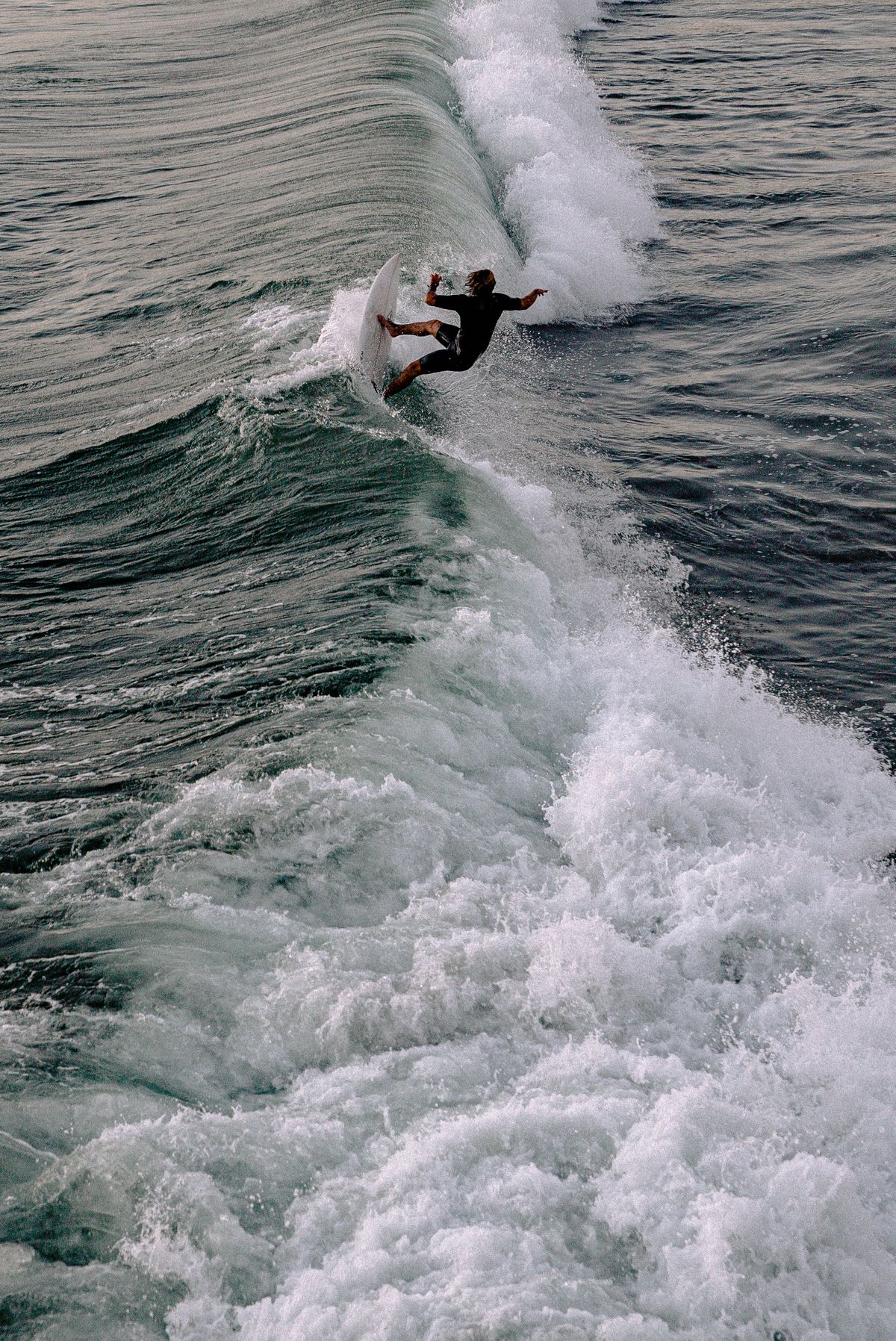
The unbroken green wave is where surfing looks like the videos. It is also the wrong place to start. For your first stand-up you want whitewater: the white, foamy, already-broken part of the wave that rushes towards the beach.
Whitewater is forgiving. It is slower than the green face, it pushes you straight in a predictable line, and it does not pitch you forward. You get a few long seconds of push, which is exactly what you need while you are still learning the movement. The green wave asks you to read it, time it and angle along it. Whitewater just asks you to stand.
You read whitewater by watching where the foam is still moving with force. A fresh wall of white that is surging towards the beach will carry you. A patch of flat, fizzing foam that has run out of energy will not. Point the board at the beach, lie down, and let the foam catch the tail. When you feel the push take you, that is your cue.
The pop-up, broken down
The pop-up is one movement, done fast, in this order:
1. Paddle with the wave. As the whitewater reaches you, take a few strong paddles so the board is already moving when the foam hits. You cannot pop up on a board that is sitting still. 2. Feel the push. The wave lifts the tail and the board starts gliding on its own. Now your hands matter more than your arms paddling. 3. Hands flat, under your chest. Plant both palms flat on the deck beside your ribs, not out in front of your shoulders. Thumbs roughly under your nipple line. 4. Push your chest up. Straighten your arms and lift your upper body off the board, like the top of a push-up. Your hips and legs stay low. 5. Feet under you in one go. Slide your back foot up to roughly the tail-side third of the board and your front foot up under your chest at the same time. Do not go to your knees. Jump the feet through the gap your pushed-up chest just made. 6. Stand low. Feet across the board, roughly shoulder width, knees bent, weight centred. Chest up, eyes on the beach.
Your feet land where they land the first few times. Aim for the front foot over the middle of the board and the back foot near the traction pad or tail. Too far back and the nose lifts and you stall. Too far forward and the nose digs and you go over it.
Positioning and paddling basics
Before any of that, you have to be lying in the right place on the board. Too far forward and the nose ploughs underwater. Too far back and the board drags and the foam passes under you without catching.
Find the sweet spot on dry land first. Lie on the board. The nose should sit about a hand's width above the ground, floating level, not plunging and not pointing at the sky. Memorise where your body is when it balances there. That is your paddling position.
Paddling is long and deep, one arm at a time, reaching forward and pulling water back past your hip. Keep your head up and the board pointed straight at the beach. The point of paddling is not speed for its own sake. It is matching the board's speed to the wave's speed so the foam can take you cleanly. A board already moving needs only a nudge from the wave. A board sitting still gets left behind.
A bigger board makes all of this easier. More volume means more float and more stability, which buys you time to get your feet under you. That is why we put every beginner on a soft foam board. It is slower to turn and that is the point: it holds still long enough for you to stand.
Common mistakes, and how to fix them
Nearly every first-timer makes the same handful of errors. They are easy to fix once you know them.
- Going to your knees. The single most common one. It feels safer, but it builds a habit you then spend weeks unlearning. Fix: commit to the full pop-up on sand until feet-under-body in one movement feels normal.
- Looking down. Where your eyes go, your weight goes. Stare at your feet and you fold forward over the nose. Fix: pick a point on the beach and look at it the whole way in.
- Popping up too early. Standing before the wave has actually got you moving. You stand on a static board and sink. Fix: wait to feel the push take you, then go.
- Hands too far forward. Palms out by your shoulders turn the pop-up into a slow, weak press. Fix: plant your hands flat beside your ribs so your arms have real leverage.
- Standing up tall and stiff. Straight legs mean no balance and no shock absorption. Fix: stay low, knees bent, like you are about to sit on a low stool.
- Stopping halfway. Hesitating in the middle of the movement is where most falls happen. Fix: the pop-up is explosive and continuous. Paddle, push, plant the feet, stand, no pause between.
None of these mean you are bad at surfing. They are the normal cost of learning a new movement. Watching from the edge with a coffee while someone talks you through them is also a legitimate part of the day.
Practise on land before the water
The pop-up is a motor pattern. The faster it becomes muscle memory, the less you have to think in the water, and thinking in the water is what slows you down.
Draw the outline of a board on the sand, or use the board itself laid flat. Then run the full sequence, slowly at first:
- Lie down in your paddling position, hands flat beside your ribs.
- Push your chest up and jump both feet under your body in one movement.
- Land low, feet across the line, knees bent, eyes forward.
- Reset and repeat.
Do it ten times slowly to get the shape right. Then do it faster, until the push and the feet happen together without a gap. Twenty clean pop-ups on sand will do more for your first wave than an hour of thinking about it. Sand is slower than water and hurts less, so it is the honest place to make your mistakes.
Learning how to stand up surfing, session by session
Your first standing wave is a real, repeatable skill. Most beginners get to their feet in their first session or two when they start on whitewater, use a big soft board and are coached through the movement. We run surf groups of eight people maximum per certified coach, split by level, and the coach is in the water with you, pointing you into the right waves and calling the moment to stand. That is why the first ride tends to happen sooner than people expect.
Surfing is also gentler than its reputation. A peer-reviewed study of more than 1,300 surfers recorded 1.79 major injuries per 1000 hours of surfing, and beginners on soft boards in knee-to-waist-high whitewater sit at the calm end of that range. You are far more likely to end a session tired and salty than hurt.
Progress comes in layers. The first session is about standing at all. The second is about standing more often and staying up longer. By the third or fourth you start steering, then you begin turning towards the open face of the wave. The jump from whitewater to the green wave comes when standing has stopped being something you think about. That usually takes a few days of consistent sessions, which is why a week does more than a weekend.
If you want a picture of what that week actually looks like, from the morning forecast call to the afternoon in the water, read a day in the life at Big Blue Surf Experience. And if you are brand new, our surf lessons in Morocco for beginners walk through exactly how the first days are structured.
When you are ready to stop reading and start paddling, pick your dates and build your trip. The foam is already breaking towards the beach. The rest is just doing it in order.
Questions people ask
How long does it take to stand up surfing?
Most beginners stand up on a whitewater wave within their first lesson or two when they are taught the pop-up properly and start on the right waves. It is a real skill you can repeat, and it rewards practice.
Should I learn on my knees first?
No. Going to your knees builds a habit you later have to unlearn. Practise the full pop-up from lying to standing in one movement, first on sand, then in the water.
What size board should a beginner use to stand up?
A big, soft foam board. More volume means more stability and more float, which gives you time to get to your feet. We put every beginner on a soft board for exactly this reason.
Is surfing dangerous for beginners?
Surfing is relatively low risk. A peer-reviewed study recorded 1.79 major injuries per 1000 hours of surfing across all surfers. Beginners on soft boards in whitewater, with a coach in the water, are at the gentler end of that.